
Board work in a workflow: from meeting to follow-up
Effective board work rarely involves more documents or more meetings. It involves clear processes: the right documentation at the right time, good decisions, and follow-up that ensures decisions are implemented. In practice, board work is a coherent workflow.
Many organizations—from associations and foundations to companies—face a recurring challenge: the board's work changes tools between each step. Supporting documentation and versions exist in documents, decisions are formulated in meetings, minutes are finalized afterwards, tasks are followed up elsewhere, and history becomes dependent on individuals rather than the organization.
Reduca's idea is simple:bring all board work together in a shared workspace where each step builds on the last.
Start your free trial – invite the rest of the board later.
Why workflow is more important than tools
There is plenty of advice on how to make board meetings more effective: have a clear agenda, share materials in advance, focus the minutes on decisions and tasks, and follow up consistently. The Institute of Directors, for example, emphasizes that minutes should cover decisions, tasks, and responsibilities—and that follow-up after the meeting is essential.
Research and experience-based analyses of board work also point to the importance of basic disciplinein the processes: agendas, preparations, decision-making processes, and meeting management, which free up space to deal with more complex issues.
Governance guidelines (e.g., OECD) reiterate the core principle: Board members are expected to act on a well-informed basis, with care and responsibility. To do so, the board needs a working method that makes information and decisionstraceable and consistent over time.
This is precisely where a workflow can be beneficial. When documentation, decisions, signing, and follow-up are integrated, board work becomes:
- easier to implement
- easier to follow up
- easier to hand over
A coherent workflow in practice
1) Prepare for the meeting
A good meeting begins before you meet. In Reduca, you gather:
- agenda and tasks
- supporting documents and documentation
- planning linked to calendar and annual cycle
This provides a common starting point where the board sees the same information and where the meeting can be more focused.
2) Meetings & decisions
During the meeting, the focus is on capturing what is important:decisions and responsibilities. Best practice for minutes and meeting notes emphasizes that decisions and action items should be clearly documented.
In Reduca, decisions are documented in the same structure as the meeting. This means that:
- decisions can be linked to tasks
- responsibility can be linked to individuals
- Follow-up can continue after the meeting without anyone having to "translate" the minutes.
3) E-signing
When the meeting is over, the board should be able to close the loop. With e-signing, you can sign minutes and attachments directly in the platform. This makes the process both faster and clearer.
4) Tasks and follow-up
The biggest difference between "we made a decision" and "we implemented it" is follow-up. In Reduca, decisions become tasks and responsibilities that live on between meetings, so that the board can:
- view status
- follow up at the next meeting
- build continuity in the work
5) Communication
Board work often requires brief coordination between meetings. When communication is linked to meetings, decisions, and tasks, it becomes easier to follow—and easier to take over.
6) Documents
Documents should not just be stored—they should be available in the right context. In Reduca, documents are located where they are used: linked to meetings, agreements, decisions, and follow-ups.
7) Agreements & responsibility
Agreements often become critical parts of the board's work, especially in associations and foundations. When agreements and responsibilities are linked to decisions and history, it becomes easier to understand:
- what was decided
- when it was decided
- who is responsible
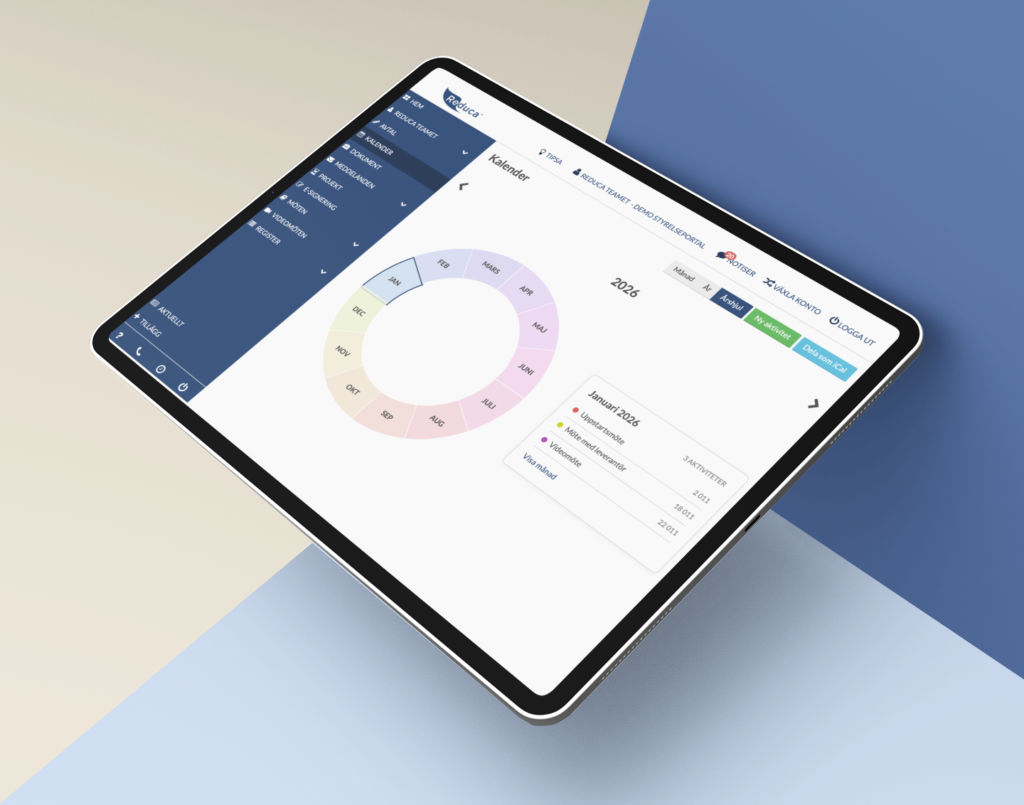
8) Calendar & annual cycle
Annual cycles and calendars create rhythm: recurring meetings, budget cycles, reporting, annual general meetings, and planned activities. When planning is located in the same workspace as meetings and decisions, it becomes easier to keep the year organized.
9) Video meetings
For boards that meet remotely or in hybrid form, it is important that the meeting takes place close to supporting documents and notes. With video meetings in the same workspace, the meeting becomes part of the workflow, not a separate event.
10) History & traceability
Here, the workflow becomes particularly clear: everything created during the work automatically becomes part of the history. This allows the board to follow reasoning and decisions over time – and makes the handover between terms of office much easier.
Why this matters for board quality
When the board's work is coordinated, it becomes easier to devote time to the right things: governance, priorities, and long-term issues. Process discipline around agendas, documentation, and decisions frees up space to deal with more complex issues as they arise.
In addition, it becomes easier to act on a well-informed basis when the information is collected and traceable in its context.
Try Reduca at your next meeting
You can start right away with the next meeting and let the work build up as you use the platform.
Start your free trial – invite the rest of the board later.
