








Board minutes
– guide, examples, and template
Board minutes are the formal documentation of a board meeting. The minutes summarize the issues that were discussed, the decisions that were made, and the people who participated in the meeting.
For associations, foundations, and companies, board minutes are an important document because they show how the board has worked and which decisions form the basis for the organization's activities.
Clear and structured protocols make it easier to follow up on decisions, create transparency in board work, and preserve the organization's history.
What is a board meeting minutes?
Board minutes are a document that summarises a board meeting and the decisions made during the meeting. The minutes serve as official documentation for the organisation's work and can in some cases also be used for auditing or follow-up purposes.
Well-written board minutes should provide a clear picture of:
-
when the meeting was held
-
who participated
-
what issues were discussed
-
what decisions were made
The minutes do not need to reproduce the entire discussion,
but it should clearly describe what decisions have been made and what actions are to be followed up on.
Why are board minutes important?
1. Documentation of decisions
The minutes show the decisions made by the board and serve as a reference for future work.
2. Structure and follow-up
Minutes make it easier to follow up on previous decisions and ensure that tasks are carried out.
3. History
Over time, the protocols create a history of the organization's work and development.
Tips for writing good board minutes
Focus on decisions
The minutes do not need to contain all the details of the discussions.
The most important thing is that decisions are clearly documented.
Use a clear structure
By using the same template every time, the protocols become easier to write and read.
Write concisely and clearly
Avoid lengthy formulations
and focus on what is relevant to the work of the board.
Save the minutes
When minutes are stored in a clear and organized manner, it becomes easier to find previous decisions and follow up on the work of the board of directors.
What should be included in board minutes?
1. Basic information
The following information should be included at the beginning of the minutes:
name of the organization
date of the meeting
location or meeting format (physical or digital)
who participated
who was absent
2. Agenda items
The minutes usually follow the meeting agenda and deal with each item in order, for example:
approval of the agenda
review of previous minutes
financial report
operational issues
new decisions
3. Decision
The most important aspect of the minutes is to clearly document the decisions made by the board. The following should be stated:
what the decision means
who is responsible for follow-up
when the decision is to be implemented
4. Adjustment and signing
When the minutes are complete, they must be reviewed and approved, and are usually signed by:
chairperson
recording secretary
verifier
This confirms that the minutes accurately reflect the decisions made at the meeting.
Download template for board minutes
Would you like to use a ready-made template for board minutes?
Download our template, which can be used by associations, foundations, and companies.
Manage board minutes digitally in Reduca
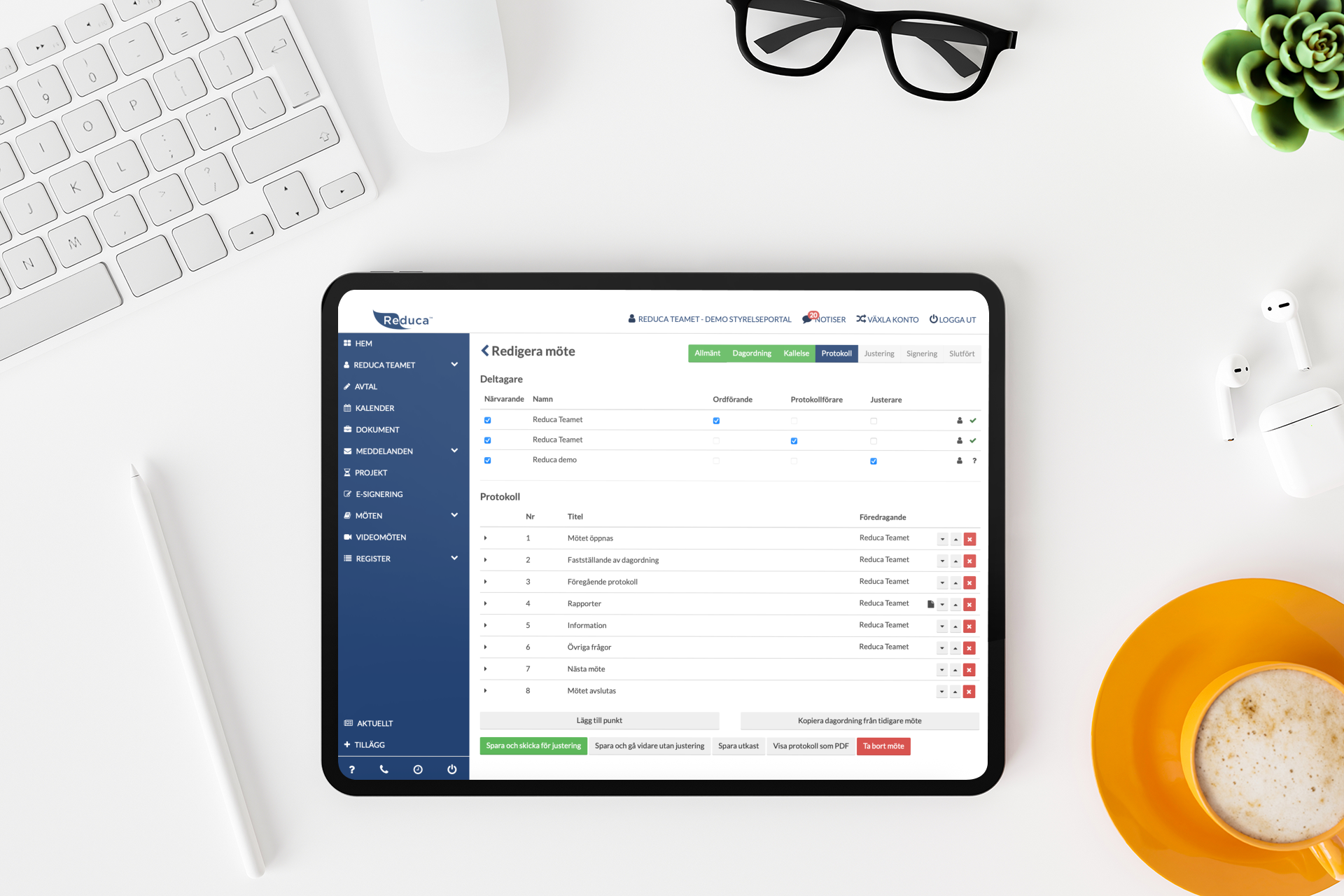
With Reduca, boards can write, store, and follow up on board minutes directly in the platform, together with meeting materials and decisions.
- Plan, create, and conduct board meetings
- Collect, manage, and share meeting materials
- Send out notices, write and sign board minutes
- Create decision logs and assign tasks
Get started with Reduca
Reduca provides you with the structure for meetings, decisions, and follow-ups—
—so that the board can focus on operations instead of administration.
Keep yourself updated on the latest news
Reduca launches a partnership with the Swedish Padel Federation
Reduca has launched a partnership with the Swedish Padel Federation with the aim of streamlining and digitizing board work in padel clubs. Padel is one of Sweden’s fastest-growing sports, and more and more clubs are being formed across the country. At the same time, many clubs are largely run on a volunteer basis, which means that board work often needs to be efficient and structured to function effectively over time. Through […]
Things to keep in mind before, during, and after the annual meeting
The annual general meeting is one of the most important events of the fiscal year. It is where key decisions are made, the board is held accountable, and members gain insight and the opportunity to influence the organization. With the right preparation and structure, the annual general meeting can be both efficient and engaging. Here, we’ll go over what to keep in mind before, during, and after the meeting—as well as […]
What's New in Reduca: Smarter Workflow and a Digital Annual Cycle for the Board
Today’s board work places ever-greater demands on structure, transparency, and effective collaboration. With Reduca, you can consolidate the entire board process into a cohesive workflow—from planning to execution and follow-up. We are now launching an update with several new features and improvements, with a particular focus on enhancing overview and planning through our enhanced annual cycle. A […]
Digital and free of charge
Book a demo
During a demo you will:
- Review of the platform
- Answers to questions and concerns
- Tips and suggestions
